
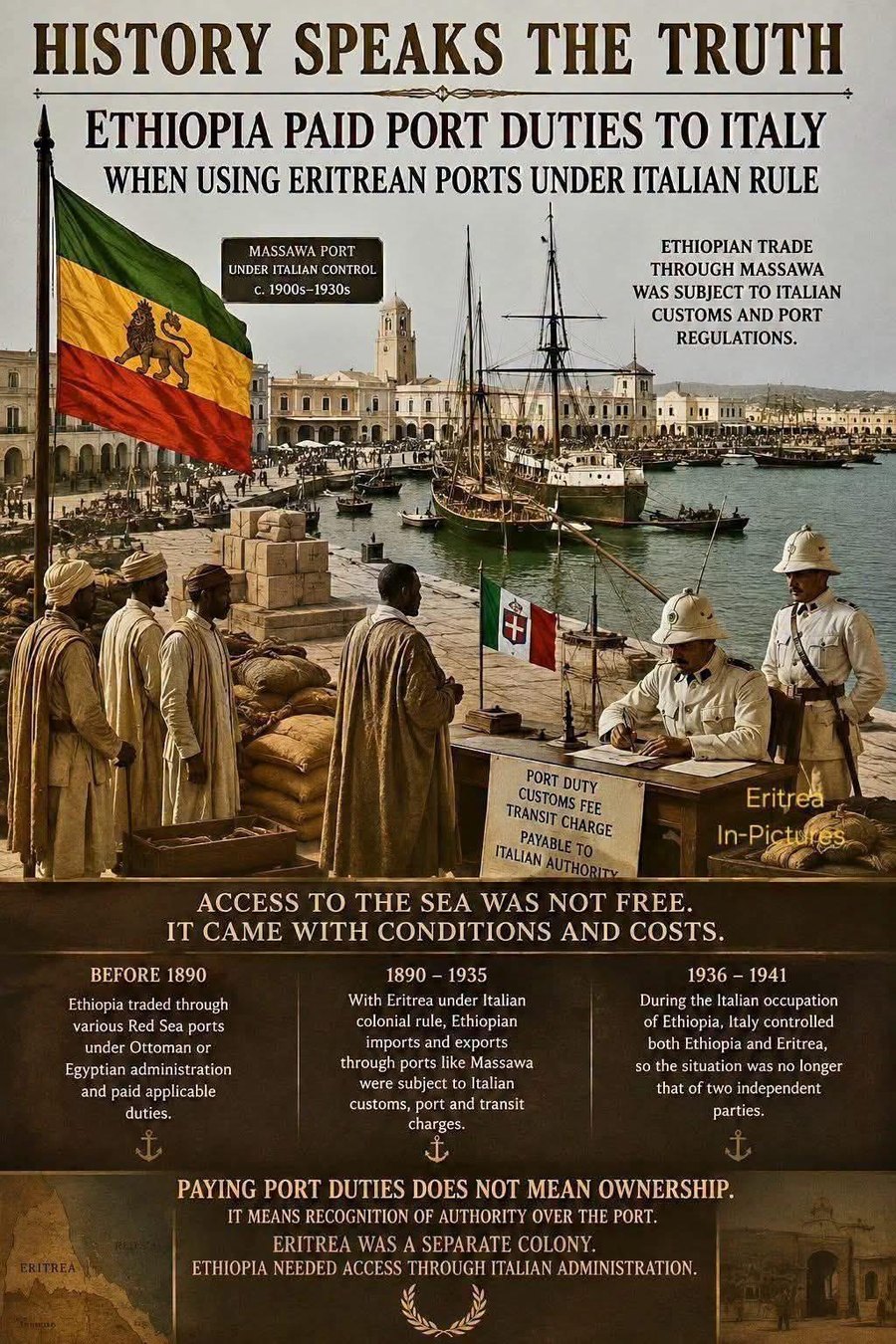
Ethiopia, Eritrean Ports, and the History of Port Duties: What the Archives Show
A common misconception in discussions about the Horn of Africa is that Ethiopia historically owned and freely used the ports of the Eritrean coastline. Colonial customs records, trade treaties, and port administration archives tell a very different story.
Access to the sea was never free. It always came with conditions and costs, paid to whatever power controlled the coast.
Before 1890: Trade Under Ottoman and Egyptian Authority
Before European colonization, the Red Sea coast was administered by the Ottoman Empire and later by Egypt. Abyssinian merchants trading through ports like Massawa, Zula, and Assab operated as foreign traders. They paid customs duties, anchorage fees, and transit charges to the Ottoman and Egyptian authorities. The ports were not administered from the Abyssinian highlands.
1890 - 1935: Eritrea as a Separate Italian Colony
This is the most legally significant period.
In 1890, Italy formally established the Colony of Eritrea. From 1890 to 1935, Eritrea existed as a distinct colonial entity with its own administration, budget, and customs regime, separate from Abyssinia.
During this time, all Abyssinian imports and exports that used Massawa and Assab were classified as foreign commerce. They were subject to Italian customs law and were required to pay:
- Port duties
- Customs fees
- Transit and warehousing charges
These fees were payable to the Italian colonial authority. This was not an internal transfer. It was a state collecting revenue from a neighboring foreign state. Under international law, a sovereign does not pay customs duties to another state to use its own territory.
The various Italo-Abyssinian treaties of this era, including trade agreements signed under Menelik II, explicitly recognized this arrangement. Abyssinia was granted access through Italian Eritrea, not ownership of it.
1936 - 1941: Italian East Africa
For five years, following Italy's invasion and occupation of Abyssinia in 1935-36, both Abyssinia and Eritrea were merged into Italian East Africa. For that brief period, the distinction disappeared because both territories were under a single colonial power. This period was a result of fascist occupation and was declared illegal by the international community. When Italian rule and colonization ended in 1941, Eritrea did not become part of Abyssinia. It became a British administered territory pending a UN decision on its future.
The Principle That Endures
Paying port duties does not mean ownership. It means recognition of another authority's sovereignty over the port.
Today, Ethiopia pays port fees to Djibouti, and commercial fees to use Berbera and Lamu. That commercial relationship does not make those ports Ethiopian.
The same principle applied a century ago. The fact that Ethiopian traders paid port duties to Italy for the use of Massawa and Assab proves that Eritrea was administered as a separate colony and that Abyssinia needed foreign administrative permission to access the sea.
Eritrea was not a province that was later separated. It was a separately colonized territory that later completed a 30-year war for independence in 1991 and was recognized as a sovereign state in 1993 following a UN-monitored referendum.
#Followers #Highlights #Eritrea #Ethiopia
Source: Worldwide Pan Africanism. View the original Facebook post.