
Respect for sovereignty, peaceful coexistence and shared, sustainable development for Djibouti, Eritrea, Ethiopia and Somalia
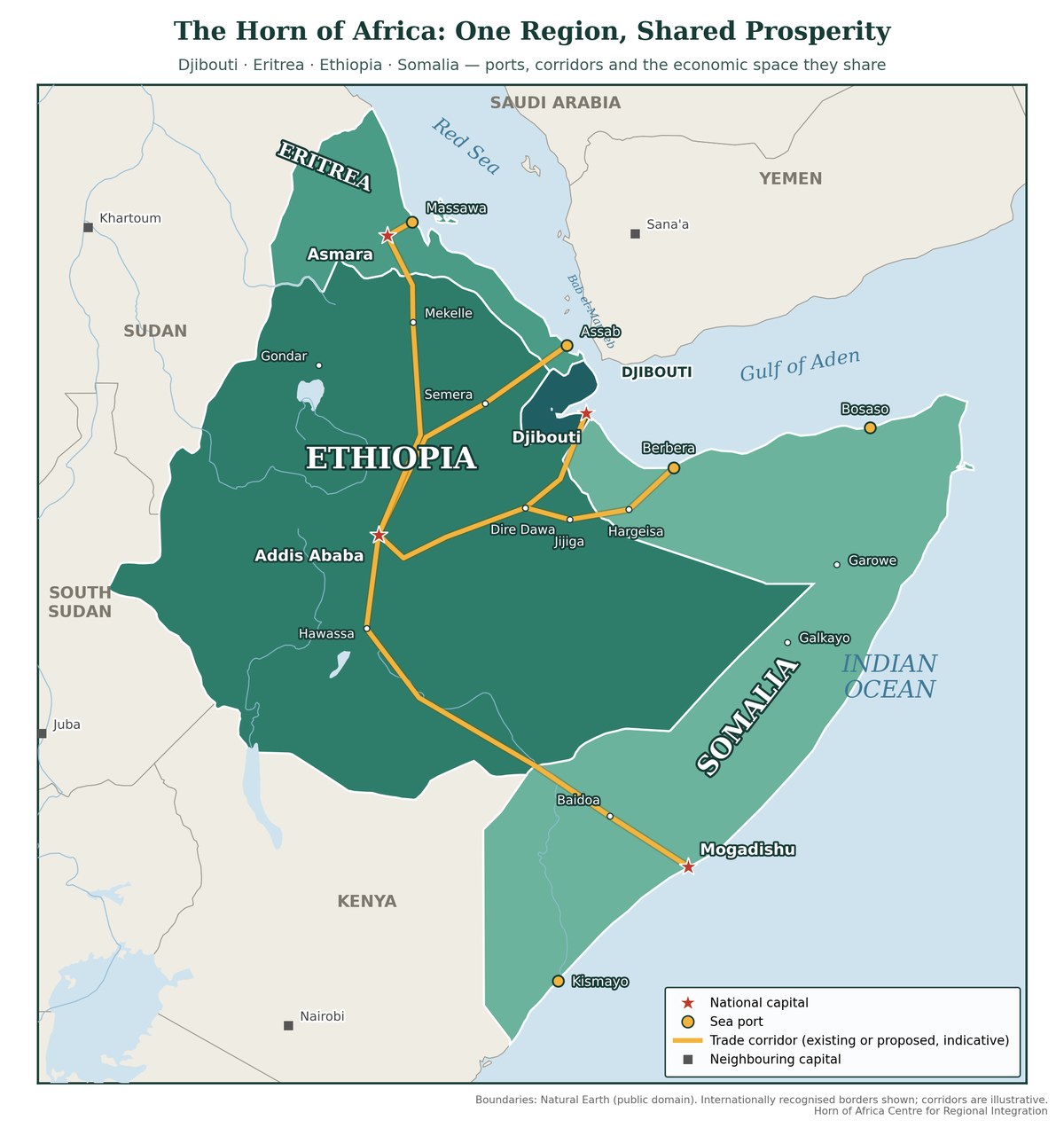
Look at a map of the Horn of Africa and one fact jumps out before any border does. Geography has already integrated this region; only politics keeps it apart. Ethiopia, home to some 130 million people and one of Africa's largest economies, has no coastline. Djibouti, Eritrea and Somalia between them hold some of the most strategically valuable shoreline on earth: the Red Sea, the Bab el-Mandeb Strait through which a large share of world trade passes, the Gulf of Aden, and the longest mainland coastline on the African continent. Each country holds what the others need. Together, these four states represent well over 150 million people, a young and growing workforce, abundant renewable energy, vast livestock wealth and a gateway between Africa, Arabia and Asia.
The question is not whether these four nations are economically interdependent. They already are. The question is whether that interdependence will be managed through suspicion and rivalry, or organised deliberately through cooperation, law and mutual respect. This article argues for the second path, and for beginning where success is most achievable and most tangible: economic integration, as the foundation on which a closer and more lasting union can be built over time.
A region at a crossroads
It would be dishonest to write about integration without acknowledging how difficult the present moment is. Relations between Ethiopia and Eritrea have deteriorated sharply since the 2022 Pretoria Agreement, with the two governments trading serious accusations through 2025 and 2026, and with rhetoric over sea access and the port of Assab raising fears of renewed conflict. The rift between Ethiopia and Somalia that followed the January 2024 memorandum of understanding with Somaliland has been partly repaired through the Ankara process and subsequent high-level talks, but trust remains fragile. Renewed fighting in northern Ethiopia now threatens the very road and rail routes that link Addis Ababa to the port of Djibouti, the economic artery on which the whole region depends.
These tensions are real, but they are not destiny. Much of today's friction stems from a single, unresolved economic question: how a landlocked nation of 130 million secures reliable, affordable and diversified access to the sea, and how its coastal neighbours benefit from providing it without any loss of sovereignty. Framed as a territorial claim, that question leads to confrontation. Framed as a commercial and developmental partnership, it becomes the most powerful engine for shared prosperity the region has ever had.
Sovereignty is the foundation, not the obstacle
Any credible vision of integration must begin with an unambiguous commitment: the sovereignty, territorial integrity and internationally recognised borders of Djibouti, Eritrea, Ethiopia and Somalia are not negotiable. This includes the unity of Somalia, Eritrea's hard-won independence, Djibouti's status as a sovereign maritime state and Ethiopia's own territorial integrity. The African Union has long held that colonial-era borders, however imperfect, must be respected, precisely because reopening them invites endless conflict.
Integration does not dilute sovereignty; it allows sovereign states to pool decisions voluntarily where doing so makes all of them stronger. Ethiopia's need for the sea is legitimate. So is Eritrea's insistence that its ports are its own, and Somalia's insistence that agreements affecting its territory are made with its federal government. These positions are reconcilable through long-term commercial port concessions, equity partnerships, joint logistics companies, dry ports and transparent tariff agreements. Access through partnership will always be cheaper, safer and more durable than access through pressure.
Why economics must come first
History offers a clear lesson. The European Union did not begin with a constitution or a flag. It began in 1951 with six countries, recently at war with one another, agreeing to pool their coal and steel. Shared material interests produced habits of cooperation, those habits produced institutions, and those institutions eventually made war between former enemies unthinkable. ASEAN in South-East Asia and the East African Community closer to home have followed variations of the same path.
The Horn has already glimpsed this possibility. In September 2018, the leaders of Eritrea, Ethiopia and Somalia signed a Joint Declaration on Comprehensive Cooperation in Asmara, and the electrified Addis Ababa–Djibouti railway had just entered service. For a brief moment the region imagined itself as a single economic space. That moment faded because it rested on personal relationships between leaders rather than on institutions, binding agreements and the interests of ordinary citizens. The next attempt must be built differently: from the ground up, around concrete projects whose benefits are felt in markets, households and pay packets.
A practical agenda for economic integration
Ports and corridors as shared regional infrastructure. The region should move from dependence on a single corridor to a network of complementary ones. Djibouti, which currently handles the overwhelming majority of Ethiopia's foreign trade, would remain the anchor. Berbera, Assab, Massawa, Mogadishu and Kismayo can each be developed as additional gateways under the full sovereignty of their host states, with Ethiopian and regional investors participating through long-term concessions and equity stakes. A joint corridor commission could harmonise transit fees, standards and security, so that competition between ports lowers costs for everyone rather than becoming a source of rivalry.
Energy as the connective tissue. Ethiopia's hydropower, including the Grand Ethiopian Renaissance Dam, is a regional asset. Ethiopia already exports electricity to Djibouti. Extending interconnectors to Somalia and Eritrea, alongside the region's exceptional solar and wind resources and Djibouti's geothermal potential, would lower costs for industry, reduce dependence on imported diesel and create a natural exchange: affordable clean power flowing towards the coast, trade and logistics services flowing inland.
Trade facilitation and a common market in stages. One-stop border posts, a single customs window, mutual recognition of standards and interoperable digital trade systems would remove much of the friction that makes intra-regional trade costly and informal. These steps should be aligned with the African Continental Free Trade Area and with IGAD frameworks, so that the Horn becomes a fast-moving building block of continental integration rather than a separate bloc.
Pastoralists, livestock and cross-border communities. Somali, Afar and other communities have lived across today's borders for centuries. Livestock remains among the region's most valuable exports, flowing through Berbera, Bosaso and Djibouti to Gulf markets. Shared animal-health certification, regional quarantine and market facilities, and full implementation of IGAD's protocol on transhumance would turn these communities from victims of border friction into beneficiaries of integration.
The blue economy and maritime security. Fisheries, coastal tourism, shipping services and marine conservation offer enormous untapped value. None of it can flourish without security on the Red Sea and Gulf of Aden. Joint coastguard cooperation, information-sharing and common action against smuggling, trafficking and piracy protect every state's sovereignty while lowering insurance and shipping costs for all.
Finance, digital connectivity and the diaspora. Somalia's leadership in mobile money, the growth of digital payments across the region, and remittances from millions of Horn of Africa citizens abroad, including large communities here in the United Kingdom, are powerful resources. Interoperable payment systems, a regional investment code and diaspora investment vehicles could channel that capital into productive enterprise at home.
Climate resilience and food security. Drought, floods and desertification respect no borders. Joint early-warning systems, shared water and rangeland management and coordinated food reserves are areas where cooperation is not merely beneficial but essential to survival.
A phased roadmap from economic integration to greater union
Integration should proceed in deliberate stages, each building the trust needed for the next and each delivering visible results.
Phase one: confidence and connection (the first three years). An immediate de-escalation and a structured, AU and IGAD-supported dialogue between all four governments; a ministerial council and small permanent secretariat; a joint corridor and ports commission; energy interconnection agreements; and quick wins in trade facilitation, livestock trade and maritime security.
Phase two: a free trade area and shared investment (years three to seven). Tariff elimination on regional goods, a common investment protection framework, a Horn of Africa Infrastructure and Development Fund co-financed by member states, development partners and the diaspora, and regional dispute-settlement mechanisms with real authority.
Phase three: a customs union and common market (years seven to fifteen). A common external tariff, progressive free movement of goods, services, capital and people, mutual recognition of qualifications, and coordinated industrial and agricultural policies.
Phase four: deliberating on deeper union. Only once economic integration has delivered tangible benefits, and only with the free and informed consent of the peoples concerned, should the region consider deeper political arrangements, whether confederal institutions, a regional parliament or other forms of shared governance. Union imposed from above has failed before. Union earned through shared prosperity can endure.
Fairness between unequal partners
Smaller states will reasonably ask whether integration simply means domination by their largest neighbour. That concern must be answered through design, not reassurance. Decisions on core matters should require consensus or weighted majorities that protect smaller members. Revenue-sharing and compensation mechanisms should cushion those that bear adjustment costs. Every institution should be headquartered and staffed across all four capitals. Integration that is not seen to be fair will not survive its first crisis.
Coexistence as the human foundation
Beneath the economics lies something deeper. The peoples of the Horn share faiths, languages, kinship, trade routes and a long history of coexistence between Muslims and Christians and between highland and lowland, settled and pastoral communities. Universities, chambers of commerce, faith leaders, women's and youth organisations, and the diaspora must all have a voice in this project. Student exchanges, joint research, cultural festivals and cross-border business networks will do as much to build a regional identity as any treaty.
Conclusion: choosing the shared future
The leaders of Djibouti, Eritrea, Ethiopia and Somalia face a choice that will define the region for a generation. They can allow unresolved grievances and competing ambitions to drag the Horn into another cycle of conflict, with devastating human and economic costs. Or they can recognise that each nation's prosperity is bound to that of its neighbours, and begin, project by project, to build a shared economic future on the firm ground of mutual respect for sovereignty.
The corridors, ports, power lines and markets that link our nations are not threats to independence. They are its best guarantee. Economic integration, pursued patiently and fairly, can turn the Horn of Africa from one of the world's most contested regions into one of its most promising. The first step is not a grand declaration of unity. It is the decision to start working together now.
Abdurahman Sayed (Bohashem) is a political analyst and the founder of the Horn of Africa Centre for Regional Integration.